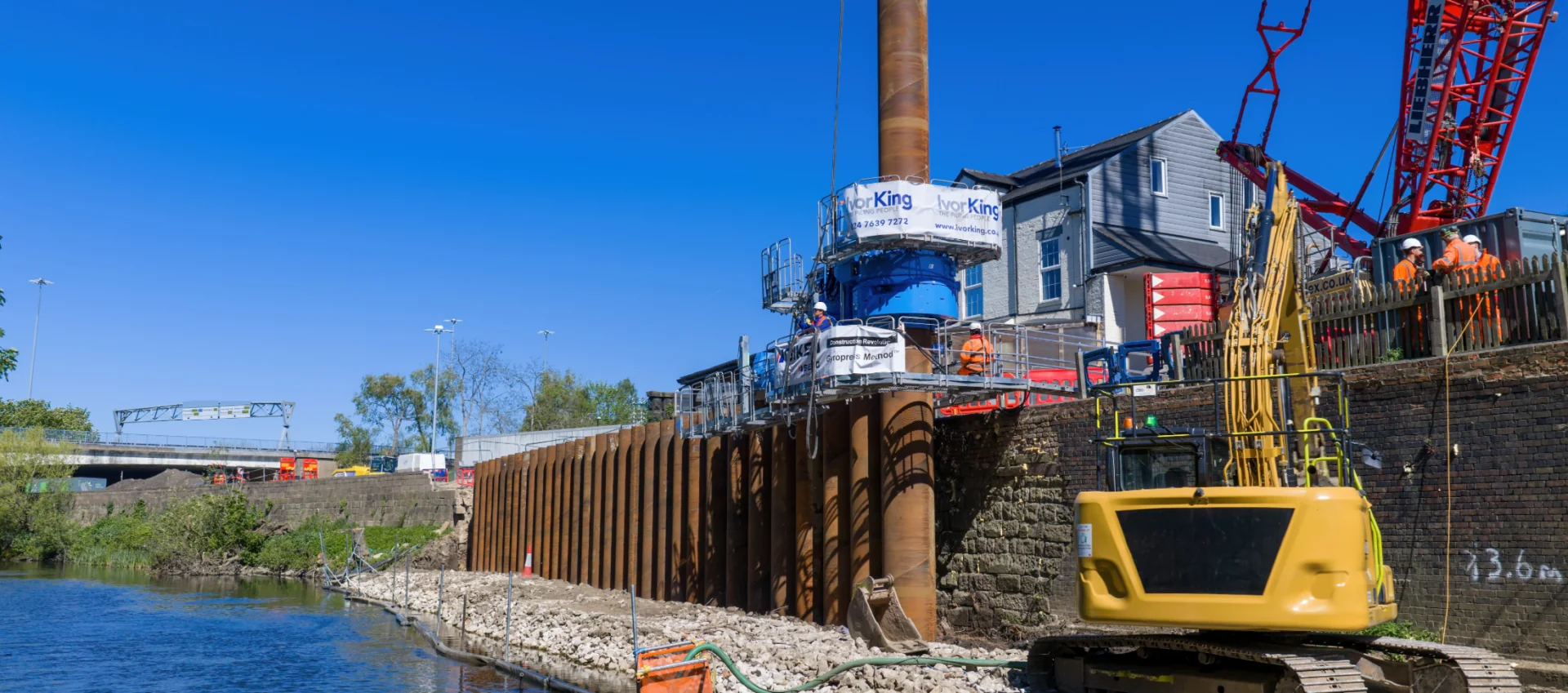
An Innovative Piling Solution for a Challenging Flood Defence Scheme
Background to the site and the works
Derby Riverside is a major flood defence and regeneration scheme designed to improve protection along the River Derwent, while helping to transform an important part of the city centre.
As part of the second phase of Derby’s ‘Our City, Our River’ programme, the Derby Riverside Flood Defences project is delivering new flood defence infrastructure along the eastern side of Derby city centre.
Ivor King was appointed by main contractor John Sisk & Son to undertake specialist piling works as part of the scheme, including a particularly challenging section around a local landmark public house dating back to the early Victorian era.
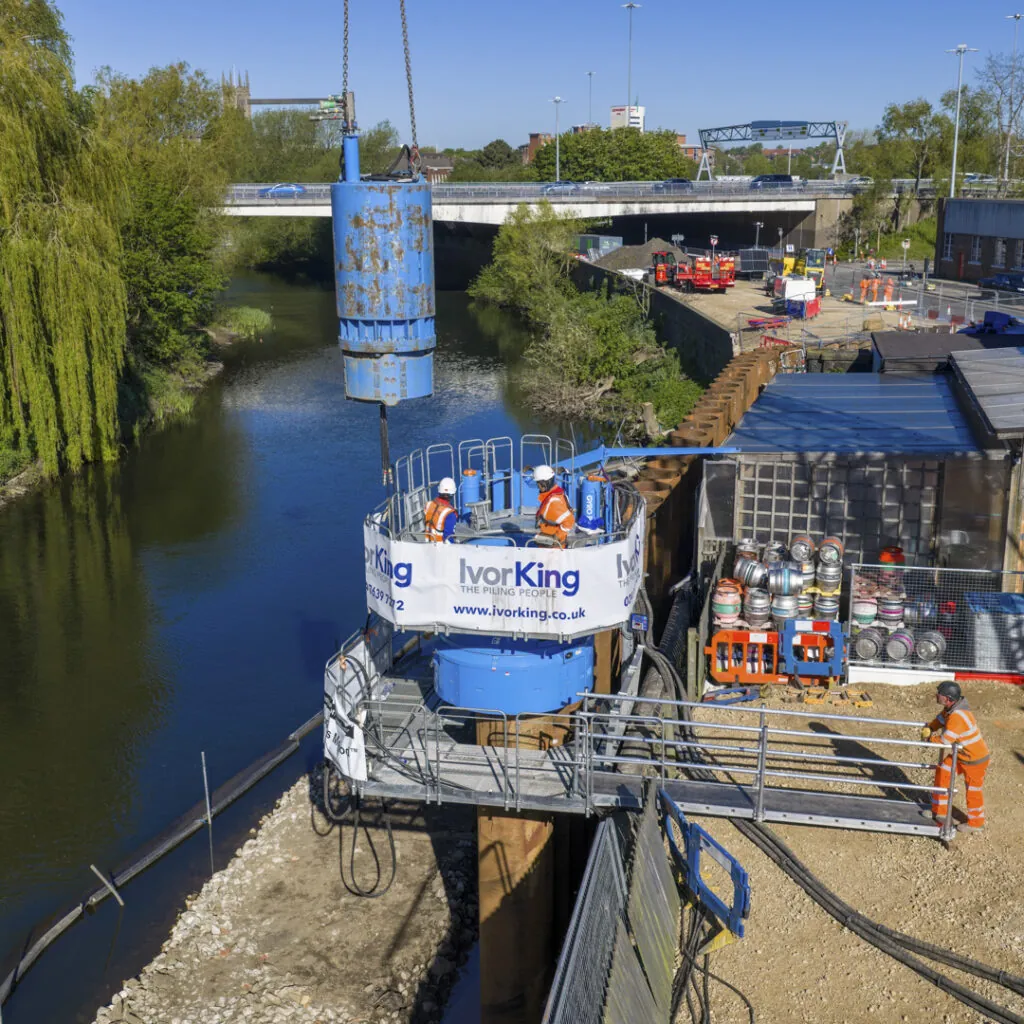
The location presented a number of challenges. The working area was narrow, positioned between the river and existing buildings, while the piling works also had to take account of existing river walls, hard ground conditions and the need to minimise impacts on the surrounding environment.
With limited working space and restrictions on noise, vibration and ground disturbance, a conventional piling solution would have presented significant challenges.
Working closely with John Sisk & Son and our partners at Giken during the pre-construction stage, Ivor King developed a bespoke approach to overcome these constraints.
The challenge
The new flood defence required a realigned flood wall around the historic Smithfield pub, with piling works required to take place in a highly constrained urban environment.
The existing river wall also formed part of the challenge. Rather than removing large sections of the existing structure before piling could begin, the project required a solution capable of working through existing obstructions while keeping disruption to a minimum.
There were several key considerations:
- Restricted working space between the River Derwent and existing buildings
- Existing river wall and hard ground presenting significant penetration challenges
- The need to minimise noise and vibration in a busy urban environment
- The requirement to reduce ground disturbance and discharged material
- The need to protect the surrounding environment, including considerations around water quality
- The importance of maintaining the integrity of nearby buildings and infrastructure
Finding the right piling solution was therefore about more than simply overcoming the ground conditions. It needed to provide the required structural performance while working safely and efficiently within a particularly sensitive location.
The solution – Giken Gyropress
The Gyropress Method is a rotary cutting press-in technique developed by Giken for installing large-diameter steel tubular piles into challenging ground conditions.
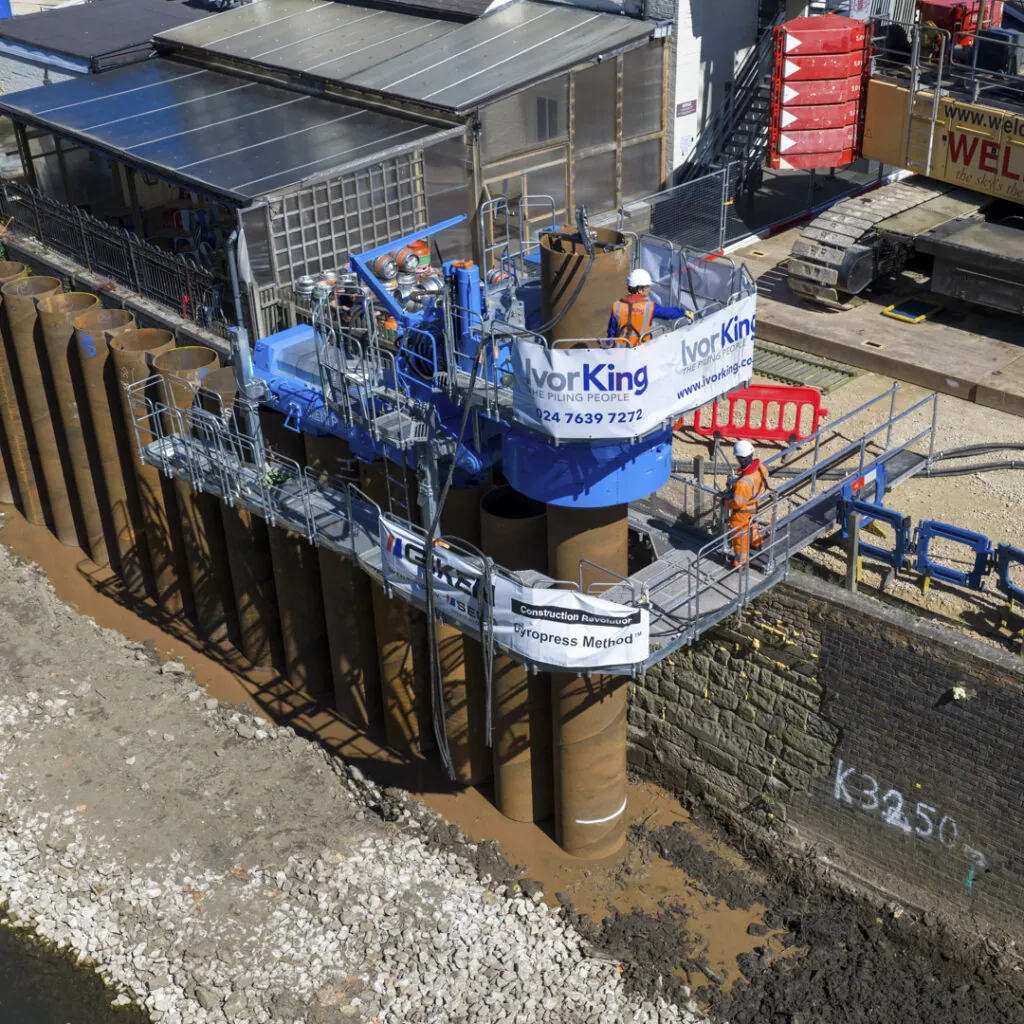
Unlike conventional piling methods, the Gyropiler combines press-in technology with rotary cutting, using specially equipped tubular piles to penetrate hard ground and existing structures.
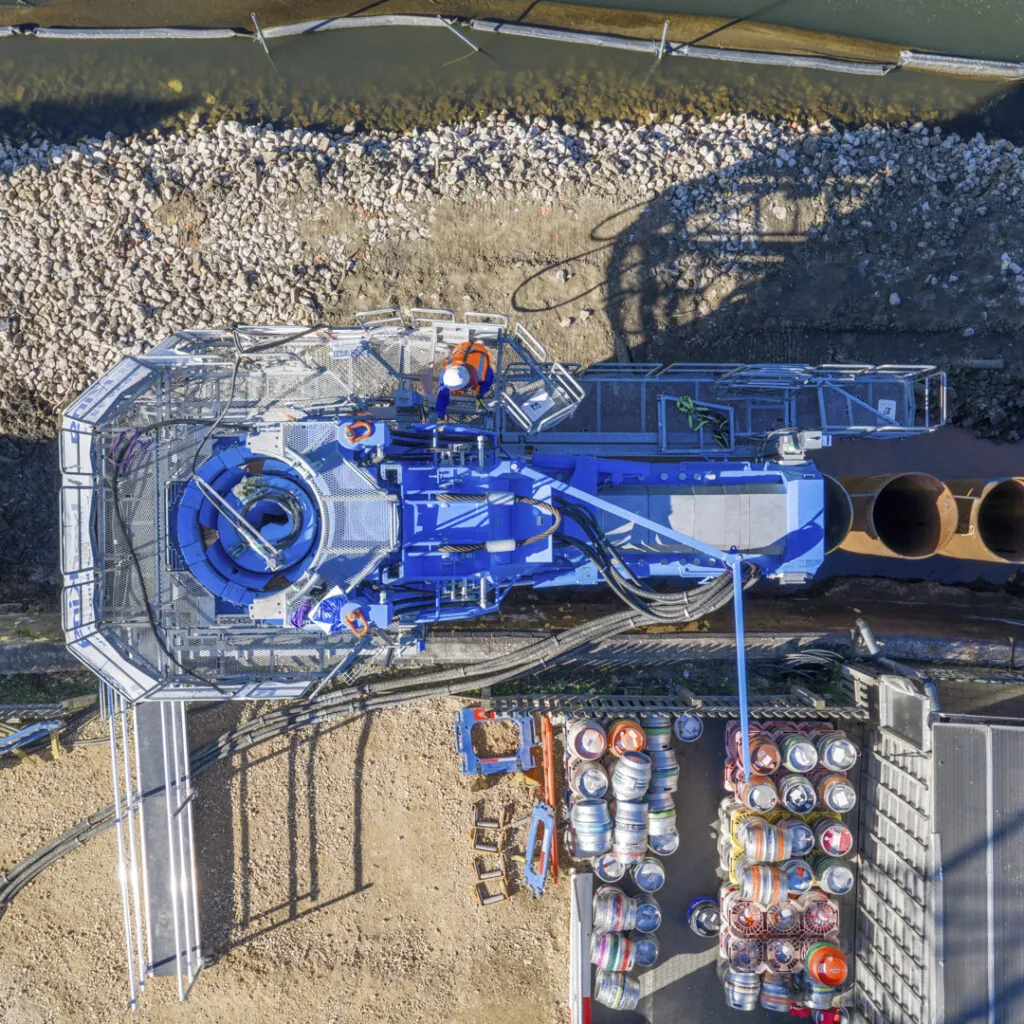
The machine grips previously installed piles and uses them for reaction force, pressing the next pile into position while simultaneously rotating it.
Once installed, the machine effectively ‘walks’ along the line of piles to the next position and repeats the process.
This approach provides a compact and controlled method of installation, making it particularly suited to sites where conventional piling rigs and temporary works would be difficult to accommodate.
At Derby Riverside, the system also allowed the tubular piles to be installed directly through sections of the existing river wall, avoiding the need for extensive removal works.
This was a key advantage in a location where space, access and environmental considerations all had to be carefully managed.
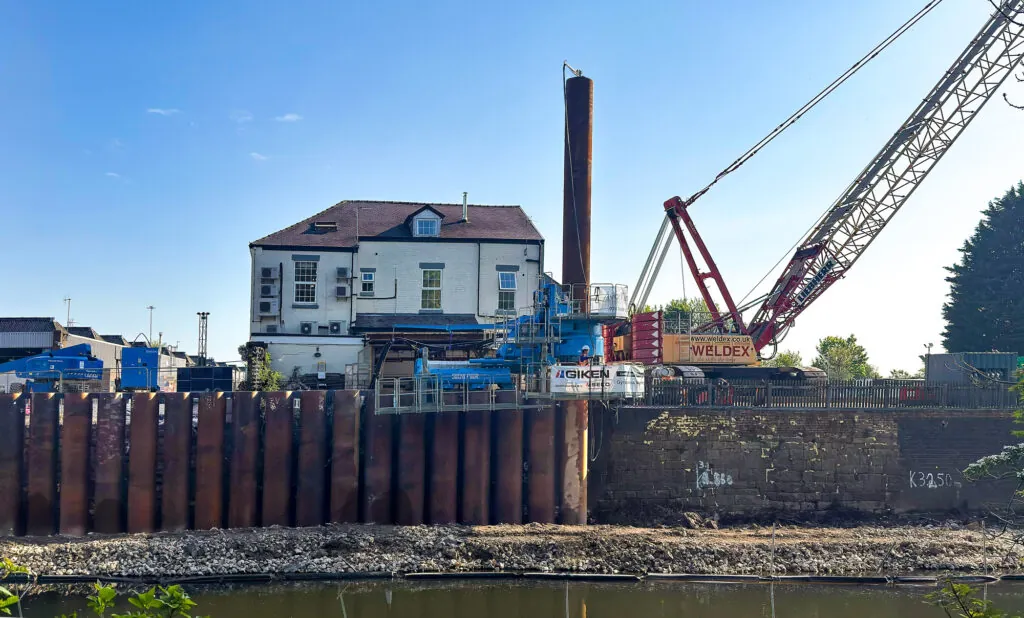
First UK application of the Gyropress Method
Derby Riverside represents a significant milestone for piling technology in the UK, with the project being the first adoption of the Giken Gyropress method in the United Kingdom.
Ivor King carried out the piling works using a Giken Gyropiler F401-G1200, supplied with support from Giken Europe.
The machine installed 93 steel tubular piles, each 16 metres long and 1,000mm in diameter, forming a high-modulus continuous retaining wall as part of the flood defence structure.
These works were subsequently followed by the installation of 192 U-profile sheet piles, each 9 metres long and 600mm wide, using a Giken Silent Piler to complete the river retaining wall for rising-water flood protection.
Minimising noise, vibration and disruption
One of the major advantages of using the Gyropress method at Derby Riverside was its ability to install steel tubes while significantly reducing the noise and vibration normally associated with traditional piling techniques.
This was particularly important given the close proximity to existing buildings, businesses and the wider city centre.
As with all Giken presses, the relatively compact Gyropiler can operate from the previously installed piles, reducing the amount of working space required and avoiding the need for large temporary platforms or extensive access arrangements.
The method also reduces the volume of soil discharged during installation, helping to limit ground disturbance and its potential impact on the surrounding environment.
For a project where flood protection, urban regeneration and environmental considerations all come together, these characteristics made the Gyropress solution particularly well suited to the site.
Overcoming existing structures
A major benefit of the Gyropress approach is its ability to penetrate through existing structures and hard ground.
At Derby Riverside, the tubular piles could be cored directly through the existing river wall rather than requiring extensive removal of the structure prior to installation works.
The rotary cutting action of the Gyropress system allows the piles to penetrate difficult ground and obstructions, including reinforced concrete and other hard materials.
This can simplify the construction process by reducing the requirement for pre-excavation and removal works – particularly valuable on a constrained site where space for conventional excavation equipment is limited.
Partnership and innovation
The successful delivery of the Derby Riverside piling works is a strong example of how collaboration during the pre-construction phase can help solve complex engineering challenges.
Ivor King worked closely with John Sisk & Son and Giken Europe to develop a solution specifically around the requirements of the site.
The result was a bespoke piling solution that allowed the project team to tackle difficult ground and existing structures while maintaining the low-noise, vibration-free principles associated with press-in piling.
Supporting Derby’s future
The wider Our City, Our River programme is intended to improve flood resilience while supporting the regeneration of Derby’s river corridor.
For Ivor King, the project has provided an opportunity to apply innovative piling technology to a real-world challenge. The first UK use of the Gyropress method also represents another step forward in our ongoing relationship with Giken and our commitment to investing in innovative piling solutions.