How temporary sheet piling supports excavations and cofferdams, from design and bracing to installation, extraction, hire and reuse.
What is temporary sheet piling?
Temporary sheet piling provides structural support for short to medium-term applications, with the intention of removing the piles once their purpose has been served. Steel sheet pile retaining walls are used where temporary earth retention or water control is required during construction. Removal is considered from the design stage, including the effect on nearby structures and the completed works.
Applications of Steel Sheet Piling for Temporary Works
Common applications include:
- Excavation support for foundations, basements and drainage works.
- Sheet piled cofferdams for bridge and river works where water and ground need to be controlled.
- Drive and reception pits for underground construction.
Planning the wall, bracing and water control
Ground conditions, excavation depth, water levels and nearby loads influence the most appropriate solution, including any waling beams, bracing frames or anchors. The design also considers wall movement and nearby structures and services.
Joint sealing, groundwater control and pumping may also be needed, depending on the site and design.
See HSE guidance on temporary works for design, installation and inspection requirements.
How are temporary sheet piles installed and removed?
The exact sequence is project-specific. A typical scheme includes:
- Sheet pile installation: Steel sheet piles are driven or pressed into position, with the installation method selected for the ground conditions, access and environmental constraints.
- Excavation: The enclosed area is excavated, with bracing and water-control measures introduced in line with the temporary works design.
- Completion and backfilling: The permanent works are completed and the excavation backfilled as required by the agreed sequence.
- Pile extraction: Temporary supports and piles are removed when the design allows and they are no longer needed.
Temporary Sheet Pile Extraction Methods
The removal of temporary sheet piles, known as extraction or ‘pulling’, can be carried out using a choice of techniques:
Silent extraction: GIKEN hydraulic pressing and extraction equipment provides an option where vibration needs to be avoided, subject to the pile arrangement, ground conditions and access.
Vibratory extraction: vibratory piling equipment, including excavator-mounted Movax attachments and leader rigs, can loosen and withdraw piles where the site permits this method.
Read more about steel sheet pile extraction.

Why Choose Steel Sheet Piling for Temporary Works?
- Cost-effective – Suitable sheet piles can be reused on subsequent projects, helping to reduce material requirements and costs.
- Reuse and recycling – Steel piles can be recovered for reuse, or recycled when no longer suitable for use.
- Versatile applications – Suitable for deep excavations, waterfront projects and urban settings, with the solution designed to suit the site.
Sheet Pile Hire and Project Costs
Temporary sheet piling costs depend on wall dimensions, pile specification, bracing, ground conditions, access and programme. Allow for installation and extraction when comparing options. Ivor King offers sheet pile hire and sale and buy-back options, with availability and terms confirmed for the project.
Why Choose Ivor King?
Ivor King has over 50 years of experience in steel sheet piling. We specialise in bespoke piling solutions, with in-house support from design through to installation and extraction.
Take a look at the range of Steel Piling Solutions we can design and install, and get in touch with our knowledgeable and friendly team to discuss your temporary sheet piling requirements. Whatever your piling project, we’re your people.
Temporary sheet piling FAQs
sheet piling solutions
Got a question? Talk to the Sheet Piling experts
Call 024 7639 7272 to speak to one of our team directly or use the button below for our online contact form.

Our knowledgeable and experienced team is here to help develop the most feasible and cost-effective solutions for your scheme, and can answer any sheet piling related questions you might have.
Temporary (or enabling) works are structures or systems used to support, protect or enable construction activities during a project. In piling, this can include temporary sheet pile retaining walls, cofferdams, bracing systems and other forms of excavation support. They are generally designed to remain in place only for as long as they are required before being removed or replaced by the permanent works.
Temporary sheet piles are commonly used to provide earth retention and water exclusion during construction, forming a controlled environment for construction to happen below ground level. Applications include supporting deep excavations, forming cofferdams, protecting existing structures and providing temporary retaining walls. Once the permanent works are complete, sheet piles can be extracted and potentially reused.
Not necessarily. The required support depends on factors including excavation depth, ground conditions, water levels and loading behind the wall. Depending on the design, temporary sheet pile walls may be self-supporting or may require waling beams or internal bracing systems.
Yes. One of the key advantages of using steel sheet piles for temporary works is that they can be extracted once they are no longer required. Extraction can be carried out using vibratory equipment or silent, vibration-free systems such as GIKEN technology, depending on the site conditions and environmental constraints.
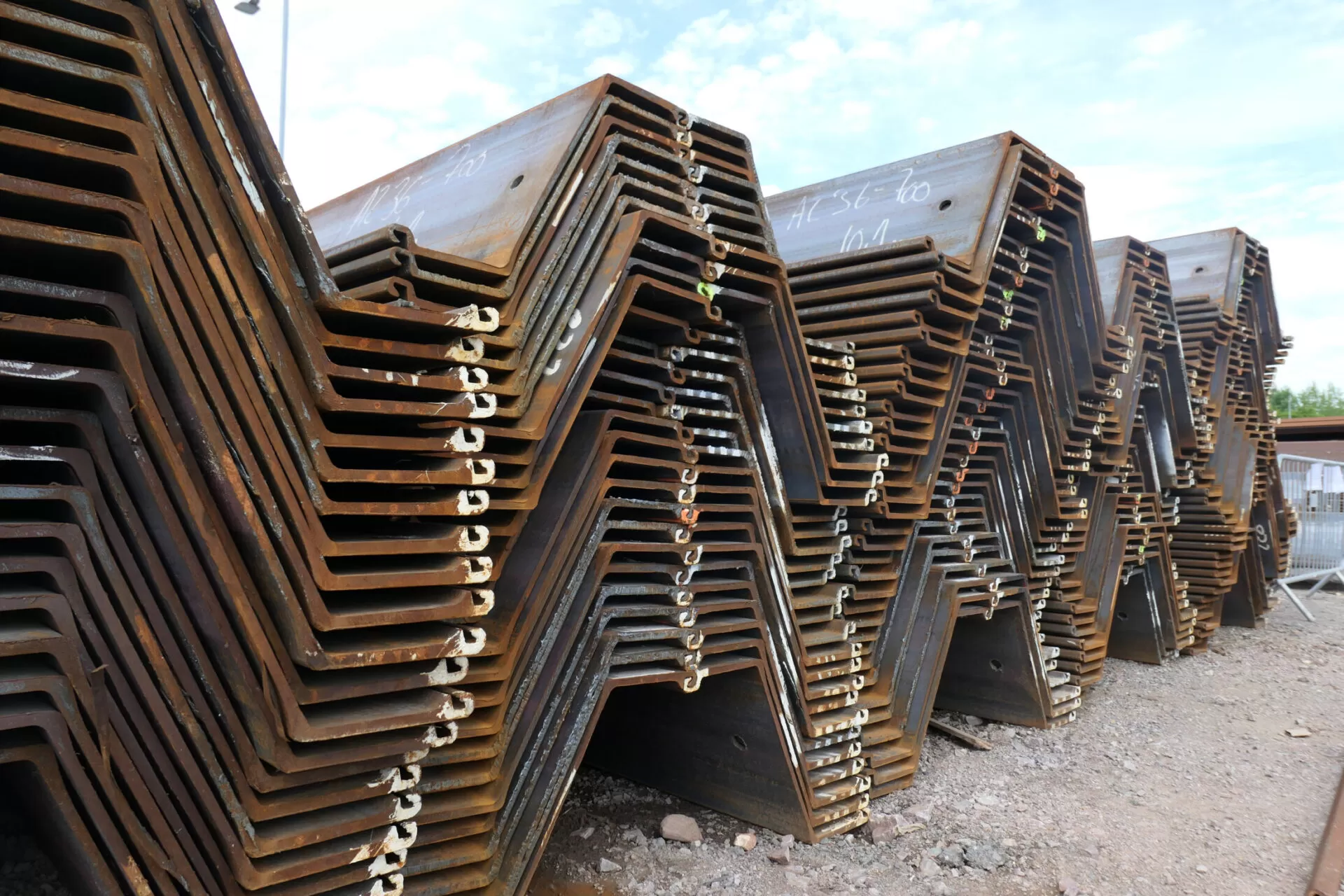
Yes. Provided the piles remain in suitable condition following extraction, they can be reused on subsequent projects. This can reduce material requirements, waste and the environmental impact associated with temporary works. Ivor King maintains more than 3,000 tonnes of U and Z sheet piles in stock for hire and sale.
The installation method depends on the ground conditions, site constraints, required pile depth and surrounding environment. Sheet piles can be installed using vibratory excavator-mounted equipment (Movax), Telescopic Leader Rigs or GIKEN silent piling hydraulic presses. The appropriate method is considered as part of the design and planning process.
Yes. Where conventional piling methods are unsuitable because of sensitive structures, neighbouring properties or other environmental constraints, silent and vibration-free pressing systems such as GIKEN can be considered. These systems can be particularly useful in built-up or sensitive locations.
Useful information includes the proposed excavation depth and layout, ground investigation information, water levels, surrounding structures and services, anticipated loads, site access and the construction programme. Early involvement allows the piling solution and installation method to be considered alongside the wider temporary and permanent works design.
Related sheet piling solutions

Sheet Pile Retaining Walls
The quick and easy solution that eliminates the need for temporary earthworks support.

Sheet Pile Basements
Maximise your basement footprint with a cost effective watertight construction solution.

Cofferdams
Allows excavation and construction in otherwise poor working environments

Temporary Sheet Pile Walls
Allowing earthworks to take place, sheet piles can be re-used on project completion

Steel Bearing Pile Foundations
Providing excellent load and resistance and high strength in compression and tension

Tied Walls & Anchorage Systems
Sheet pile walls can be strengthened using anchorage systems to ensure the stability of retaining structures

Inland Waterways & Marine Piling Solutions
Flood defences and water retention systems, including rivers, canals, harbour and dock wall stabilisations, marinas and reservoirs
Sheet Pile Hire & Sales Our dedicated hire and sales division is on hand to support all your temporary and permanent sheet pile needs